

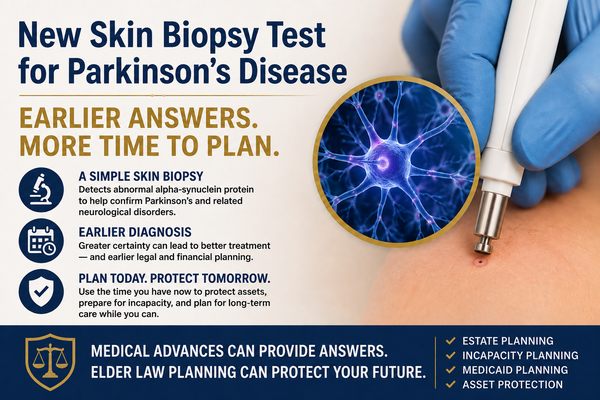
A new skin-biopsy test can now help doctors detect biological evidence associated with Parkinson’s disease and several related neurological disorders. For families dealing with unexplained tremors, balance problems, cognitive changes, or other neurological symptoms, the test may provide greater diagnostic certainty much earlier than was previously possible.
That matters medically. It can also matter enormously for Estate Planning, Incapacity Planning, long-term care planning, and Medicaid Asset Protection Planning.
Parkinson’s disease can progress slowly over many years, but it can eventually affect mobility, cognition, communication, and a person’s ability to live independently. An earlier and more reliable diagnosis gives families more time to make legal, financial, housing, and long-term-care decisions while the person with Parkinson’s can still participate fully in those decisions.
What Is the New Skin Biopsy Test for Parkinson’s Disease?
The test is called the Syn-One Test®. It uses several tiny skin biopsies to look for an abnormal form of a protein called phosphorylated alpha-synuclein in nerve fibers within the skin.
Alpha-synuclein is a naturally occurring protein found throughout the nervous system. In Parkinson’s disease and several related disorders, the protein can become abnormally folded and accumulate within nerve cells.
Diseases involving these abnormal alpha-synuclein deposits are known as synucleinopathies.
• Parkinson’s disease
• Dementia with Lewy bodies
• Multiple system atrophy
• Pure autonomic failure
Although abnormal alpha-synuclein is strongly associated with changes in the brain, it can also be detected in peripheral nerves, including nerves in the skin. That makes a relatively simple skin biopsy potentially useful as a biomarker test.
Can a Skin Biopsy Diagnose Parkinson’s Disease?
A skin biopsy can provide strong biological evidence supporting a diagnosis of Parkinson’s disease, but the test does not diagnose Parkinson’s disease by itself.
The test can detect abnormal phosphorylated alpha-synuclein associated with several different neurological conditions. A positive result therefore tells a neurologist that the patient likely has a synucleinopathy, but additional clinical evaluation is necessary to determine whether the condition is Parkinson’s disease, dementia with Lewy bodies, multiple system atrophy, or another disorder.
That distinction is important because symptoms, prognosis, treatment, and long-term-care needs can differ significantly among these conditions.
How Accurate Is the Parkinson’s Skin Biopsy?
A major study published in the Journal of the American Medical Association examined skin biopsies from people diagnosed with Parkinson’s disease and related synucleinopathies.
The abnormal protein was detected in:
• 92.7 percent of participants with Parkinson’s disease
• 96 percent of participants with dementia with Lewy bodies
• 98.2 percent of participants with multiple system atrophy
• 100 percent of participants with pure autonomic failure
• 3.3 percent of participants who did not have a diagnosed synucleinopathy
Across the four neurological disorders studied, phosphorylated alpha-synuclein was detected in 95.5 percent of participants whose diagnoses had already been confirmed by an expert panel.
Those results are impressive, but they do not mean the test is perfect.
Approximately 7 percent of study participants with expert-confirmed Parkinson’s disease had negative biopsies. A negative skin biopsy therefore does not completely rule out Parkinson’s disease.
How Is the Parkinson’s Skin Biopsy Performed?
The procedure is relatively simple and substantially less invasive than a spinal tap.
A physician numbs several small areas of skin with local anesthetic and removes tiny samples using a punch-biopsy instrument.
According to the Parkinson’s Foundation, samples are commonly taken from three locations:
• The upper back
• The lower thigh
• The lower leg
The samples are then sent to a specialized laboratory for analysis.
For patients who have spent months or years without a clear diagnosis, the ability to obtain biological evidence through several small skin biopsies represents a significant development.
Who Should Consider the Parkinson’s Skin Biopsy Test?
Not every person with Parkinson’s disease needs this test. Movement-disorder neurologists can often diagnose classic Parkinson’s disease from a neurological examination, medical history, progression of symptoms, and response to Parkinson’s medications.
The skin biopsy may be particularly useful when:
• Symptoms are unusual or difficult to classify.
• A patient has tremor, but the cause remains uncertain.
• Doctors are trying to distinguish Parkinson’s disease from another neurological condition.
• Symptoms suggest more than one possible disorder.
• Parkinson’s medications have not produced the expected response.
• The diagnosis has changed over time.
• Greater diagnostic certainty would affect treatment or clinical-trial eligibility.
• The family needs greater clarity to make long-term-care and financial decisions.
Is the Parkinson’s Skin Biopsy FDA-Approved?
The Syn-One Test is a laboratory-developed test, often referred to as an LDT.
It is not FDA-cleared or FDA-approved as a commercially manufactured diagnostic device.
That distinction should not be confused with a determination that the test is ineffective. Laboratory-developed tests operate under a different regulatory framework from many mass-manufactured medical devices.
Patients considering the test should discuss its usefulness, limitations, and interpretation with a neurologist who understands Parkinson’s disease and other movement disorders.
Does Medicare Cover the Parkinson’s Skin Biopsy?
Medicare may cover the test when it is medically necessary and ordered as part of evaluating a neurological condition, but patients should verify coverage before proceeding.
Private insurance coverage can also vary.
Before having the procedure, patients or family members should ask:
• Whether the laboratory participates with Medicare or the patient’s insurer
• Whether prior authorization is required
• Whether the laboratory analysis and physician biopsy procedure are billed separately
• What the patient may owe if insurance denies coverage
• Whether the ordering neurologist expects the test result to change diagnosis or treatment
Why an Earlier Parkinson’s Diagnosis Matters for Elder Law Planning
An earlier diagnosis of Parkinson’s disease can create something extremely valuable: time.
Families often contact an Elder Law attorney only after a medical crisis has already occurred. By then, the person may have suffered a fall, hospitalization, cognitive decline, or sudden inability to live independently.
That is the wrong time to begin planning if earlier planning was possible.
A person diagnosed with Parkinson’s disease may remain completely competent and independent for many years. That period presents an important opportunity to put legal and financial protections in place before they are urgently needed.
What Estate Planning Documents Should Someone with Parkinson’s Disease Have?
Someone diagnosed with Parkinson’s disease should have far more than a Will.
A comprehensive Incapacity Plan, Estate Plan, and likely a Medicaid Asset Protection Plan should address who will make financial and health-care decisions if the person later becomes unable to do so, how assets will be protected in nursing home level care becomes necessary at home or in a nursing home, and who will receive assets after death.
Important documents can include:
• A comprehensive durable financial power of attorney
• A detailed advance medical directive
• HIPAA and medical-information authorizations
• A revocable living trust when appropriate
• Updated beneficiary designations
• Instructions concerning digital accounts and electronic records
• Proper authority to manage retirement accounts, investments, insurance policies, real estate, and business interests
The goal is to ensure that trusted individuals have sufficient legal authority to act if Parkinson’s disease later affects cognition, communication, or physical ability.
Our article on the cognitive effects of Parkinson’s disease explains why cognitive planning can be just as important as planning for physical limitations.
Parkinson’s Disease Usually Creates Major Long-Term-Care Costs
Parkinson’s disease does not affect everyone in the same way.
Some people remain independent for many years. But almost everyone with Parkinson’s will eventually need increasing assistance with activities of daily living, such as bathing, dressing, toileting, transfers, and fall supervision.
Care may eventually include:
• In-home personal care
• Adult day care
• Assisted living
• Memory care
• Nursing-level care either at home or in a nursing home
These services can be enormously expensive.
Families who wait until extensive care is already needed may discover that their planning options have narrowed substantially.
Parkinson’s Disease and Medicaid Asset Protection Planning
A diagnosis of Parkinson’s disease, as mentioned above, should immediately prompt families to consider whether future Medicaid long-term-care benefits may become relevant.
Medicaid is the primary government program that pays for long-term custodial care for financially eligible individuals, including nursing-home care and many home- and community-based long-term-care services.
Medicaid eligibility is governed by complex financial rules involving assets, income, transfers, trusts, real estate, spouses, and timing.
For many families, the critical issue is not whether Medicaid planning will eventually become necessary. The issue is whether the family begins planning early enough to preserve the greatest number of lawful options.
One important planning tool is the Living Trust Plus® Medicaid Asset Protection Trust, which is designed to protect assets from future long-term-care expenses while also serving important estate-planning objectives.
The Medicaid five-year look-back period makes timing critically important. Waiting until nursing-home care is imminent can eliminate strategies that would have been available years earlier.
Parkinson’s Disease and Aging in Place
Many people diagnosed with Parkinson’s disease want to remain at home for as long as possible.
That requires more than medical treatment.
Families may need to plan for:
• Home modifications
• Fall prevention
• Transportation
• Medication management
• In-home caregivers
• Physical and occupational therapy
• Speech therapy
• Meal preparation
• Financial management
• Backup caregivers
• Emergency planning
Legal planning should support the medical and caregiving plan rather than operate separately from it.
A properly drafted financial power of attorney, for example, can allow a trusted agent to hire caregivers, manage property, access funds, apply for benefits, modify housing arrangements, and coordinate financial matters if the person with Parkinson’s can no longer handle everything personally.
Parkinson’s Disease Can Affect Both Physical and Cognitive Capacity
Parkinson’s disease is commonly associated with tremor, stiffness, slowed movement, and balance problems, but it can also affect cognition.
Some people eventually experience changes in executive functioning, memory, judgment, attention, or the ability to process complex information.
That does not mean a diagnosis of Parkinson’s disease automatically means incapacity. It does not.
Many people with Parkinson’s disease remain legally competent for many years.
But because cognitive impairment can occur, including Lewy body dementia and other types of dementia, legal documents should be completed and reviewed while the individual unquestionably has the capacity to understand and approve them.
Should You Change Your Estate Plan After a Parkinson’s Diagnosis?
A Parkinson’s diagnosis should trigger a review of an existing Estate Plan.
That does not mean every document must be replaced.
The review should determine whether the current plan adequately addresses:
• Future incapacity
• Long-term-care expenses
• Medicaid eligibility
• Protection of the home and other assets
• The authority of financial agents
• Health-care decision-making
• Trust management
• Beneficiary protection
• Estate administration after death
Estate Planning designed for a healthy 50-year-old may not adequately address the issues faced by someone later diagnosed with a progressive neurological disease.
What Should Families Do After a Parkinson’s Diagnosis?
After the medical issues are addressed, families should examine the legal and financial consequences while there is still time to plan deliberately.
The most important steps include:
• Confirming the diagnosis with an appropriate neurologist
• Reviewing powers of attorney and advance medical directives
• Reviewing Wills, trusts, and beneficiary designations
• Evaluating long-term-care insurance and other available resources
• Determining how future home care or facility care would be funded
• Reviewing the home and other assets from an asset-protection perspective
• Evaluating Medicaid planning before the five-year look-back becomes an obstacle
• Creating a plan for future caregiving and decision-making.
Parkinson’s Planning in Virginia, Maryland, and Washington, DC
Medicaid long-term-care rules are state-specific. A strategy that works in Virginia may not work the same way in Maryland or Washington, DC.
The Farr Law Firm focuses on Elder Law, Estate Planning, Medicaid asset protection, Incapacity Planning, and long-term-care planning for families throughout Virginia, Maryland, and Washington, DC.
We regularly help families plan for progressive illnesses such as Parkinson’s disease, Alzheimer’s disease, dementia, stroke, and other conditions that can eventually create substantial caregiving and long-term-care needs.
Families seeking a Parkinson’s disease Elder Law attorney, Medicaid Planning attorney, Asset Protection attorney, or Estate Planning attorney should begin the legal planning process before a long-term-care crisis occurs.
Frequently Asked Questions About the Parkinson’s Skin Biopsy
Can Parkinson’s disease now be diagnosed with a skin test?
A skin biopsy can detect abnormal phosphorylated alpha-synuclein associated with Parkinson’s disease and related disorders. The test supports a diagnosis but does not independently prove that a patient has Parkinson’s disease.
Does a positive Parkinson’s skin biopsy mean I definitely have Parkinson’s disease?
No. A positive result can also occur with dementia with Lewy bodies, multiple system atrophy, pure autonomic failure, and other synucleinopathies. The result must be interpreted by a neurologist together with the patient’s symptoms and examination.
Can a negative skin biopsy rule out Parkinson’s disease?
No. Some patients with clinically confirmed Parkinson’s disease have negative skin biopsies.
Is there a blood test for Parkinson’s disease?
There is still no routine blood test used by physicians to definitively diagnose Parkinson’s disease. Biomarker research is advancing rapidly, but clinical diagnosis remains essential.
Should someone with Parkinson’s disease meet with an Elder Law attorney?
Yes. A diagnosis can affect future Incapacity Planning, long-term-care planning, Medicaid eligibility, asset protection, and Estate Planning. Early planning preserves more options than crisis planning.
Can Medicaid pay for care for someone with Parkinson’s disease?
Medicaid can pay for qualifying long-term-care services for financially and medically eligible individuals, including nursing-home care and certain home- and community-based services. Eligibility rules differ among Virginia, Maryland, and Washington, DC.
When should Medicaid Asset Protection Planning begin after a Parkinson’s diagnosis?
As early as practical. Medicaid transfer rules include a five-year look-back period for many asset transfers, so waiting until nursing-home admission can substantially restrict planning options.
Medical Advances Are Giving Families More Information — Use That Time Wisely
The Parkinson’s skin biopsy is not a cure, and it is not a perfect diagnostic test.
What it may provide is something families have historically struggled to obtain: greater objective evidence about what is causing neurological symptoms.
Greater diagnostic certainty can lead to earlier treatment. It can also lead to earlier planning.
That planning should include not only neurologists and other health-care professionals, but also an experienced Elder Law attorney who understands how Parkinson’s disease can affect incapacity, long-term-care costs, Medicaid eligibility, asset protection, and the family’s estate plan.
If you or a family member has recently been diagnosed with Parkinson’s disease, dementia with Lewy bodies, or another progressive neurological condition, contact the Farr Law Firm to discuss Estate Planning, Incapacity Planning, long-term-care planning, and Medicaid Asset Protection in Virginia, Maryland, and Washington, DC.