

Alzheimer’s disease remains one of the most devastating conditions affecting older adults and their families. Researchers are now investigating an unexpected possibility: carefully timed flickering light and sound stimulation that may help slow the biological processes behind the disease.
A recent report describes how scientists are studying whether specific patterns of sensory stimulation can influence brain activity linked to Alzheimer’s. The research is summarized in the CNN article Can Flickering Lights and Sound Slow Alzheimer’s?, which highlights early clinical work exploring this unusual approach.
The idea may sound unconventional, but it is grounded in well-established neuroscience.
The Role Of Gamma Brain Waves In Memory
Your brain constantly produces electrical rhythms known as brain waves. One pattern — called gamma oscillations — is associated with memory, perception, and learning.
Researchers have discovered that these gamma waves often become disrupted in people with Alzheimer’s disease.
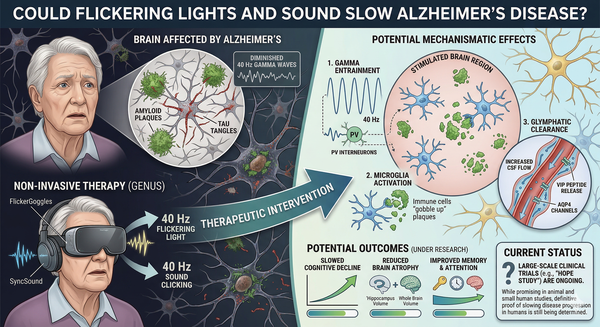
Dr. Annabelle Singer, a biomedical engineer affiliated with Georgia Tech and Emory University, has been studying whether sensory stimulation can restore these rhythms. Her research explores whether exposing the brain to light and sound pulsing at 40 hertz can synchronize neurons and restore healthy brain activity. The CNN article above discusses how these studies are attempting to use sensory signals to re-establish normal neural patterns.
The basic scientific theory works as follows:
• Alzheimer’s disease disrupts normal brain rhythms.
• Certain sensory signals can help neurons fire in synchronized patterns.
• Restoring those patterns may help the brain function more normally.
If this mechanism proves effective in humans, it could open a completely new path for treating neurodegenerative disease.
What Animal Studies Have Already Shown
The idea of gamma stimulation gained attention after laboratory studies showed dramatic effects in mice.
In one influential experiment published in the journal Nature, researchers exposed mice with Alzheimer’s-like pathology to flickering light at 40 hertz and observed a reduction in amyloid plaque buildup in the brain. The study, Gamma frequency entrainment attenuates amyloid load and modifies microglia, suggested that rhythmic stimulation may activate the brain’s immune cells.
Those immune cells — called microglia — help remove toxic proteins and debris from brain tissue.
The findings suggested that restoring gamma oscillations might help the brain clear amyloid deposits that are closely associated with Alzheimer’s disease.
However, results in animals do not automatically translate to humans, which is why clinical trials are now under way.
Early Human Trials Are Under Way
Early human studies have begun testing devices that deliver synchronized light and sound stimulation.
Participants typically wear specialized goggles and headphones that emit rhythmic signals at the same 40-hertz frequency studied in laboratory experiments.
These sessions often last about one hour per day over multiple weeks.
Initial studies suggest that:
• The stimulation appears safe and well tolerated.
• Participants can easily complete the daily sessions.
• Brain activity begins to synchronize with the external signals.
Researchers are still determining whether this synchronization leads to meaningful improvements in cognition or slows disease progression.
Why This Research Is Getting Attention
Current Alzheimer’s medications offer only modest benefits. Even newer drugs that target amyloid plaques may slow decline only slightly and often come with high costs or medical risks.
A therapy based on light and sound stimulation would represent a very different approach.
Potential advantages include:
• Non-invasive treatment
• No medication side effects
• Potential for at-home therapy devices
• Compatibility with other treatments.
Because of these possibilities, neuroscientists and medical researchers are watching the results of ongoing trials closely.
The Reality Families Should Understand Today
Even though the research is promising, this technology is still experimental. It may take years of additional trials before doctors know whether gamma stimulation meaningfully changes the course of Alzheimer’s disease.
For now, families must continue planning based on the reality that Alzheimer’s remains a major long-term care risk.
That planning typically involves:
• Preparing powers of attorney and Incapacity Planning documents
• Structuring assets to protect against long-term care costs
• Creating trusts that allow financial management if cognitive decline occurs
• Planning for the possibility of Medicaid-funded long-term care
Medical breakthroughs may eventually change the outlook for Alzheimer’s disease. But until science provides a reliable cure or prevention, thoughtful planning remains essential for protecting both families and their financial security.
Get in Touch or Schedule Your Consultation
Don’t wait for a crisis. Educate yourself, talk with those you trust, and work with a knowledgeable attorney here at the Farr Law Firm to make your decisions official.
Related Posts:
