What Is a Living Trust in Maryland, and Do You Need One?
Many Maryland residents want to make life easier for their loved ones, avoid unnecessary court involvement, maintain privacy, and prepare for the possibility of incapacity. A properly designed living trust is often one of the most effective tools for accomplishing those goals.
A living trust can serve as the centerpiece of an estate plan. It can provide instructions for managing assets during your lifetime, establish a clear plan if you become incapacitated, and govern how property is distributed after your death. Depending on how it is drafted, a trust can also help protect beneficiaries and preserve family wealth across generations.
While many people think of living trusts as tools only for the wealthy, they are frequently used by middle-class families, homeowners, business owners, retirees, blended families, and parents who want greater control over what happens to their assets.
How Does a Living Trust Work?
A living trust is a legal arrangement created during your lifetime. The person creating the trust, often called the grantor or settlor, transfers ownership of selected assets into the trust.
The trust is managed by a trustee. In most revocable living trusts, the person creating the trust serves as the initial trustee and continues managing assets normally. The trust document also names one or more successor trustees who can step in if needed.
The trust agreement contains instructions regarding who benefits from the trust, who manages it, and what happens to the trust assets both during life and after death.
Why Many Maryland Families Choose Trust-Based Planning
Living trusts have become increasingly popular because they address concerns that a simple will often cannot address by itself.
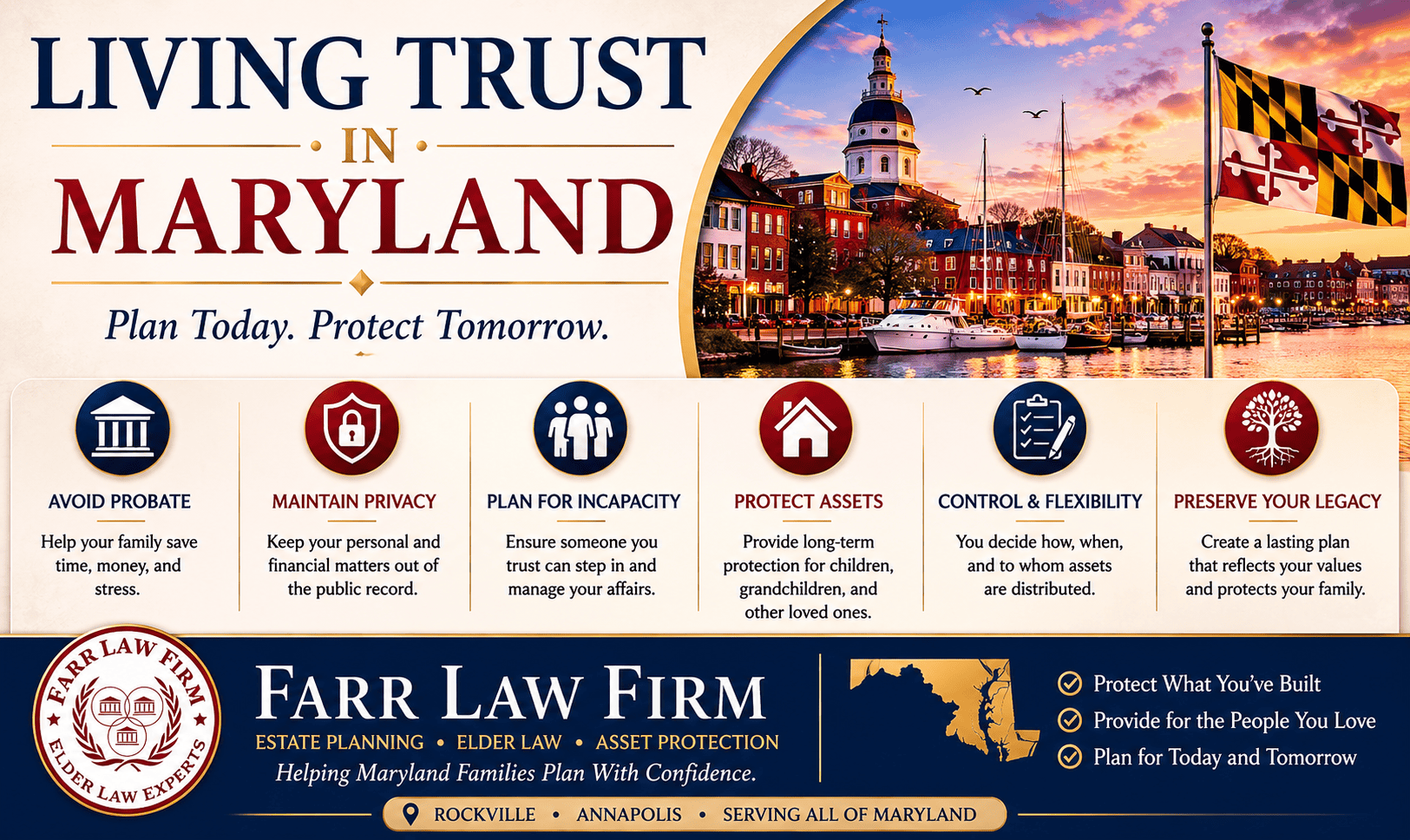
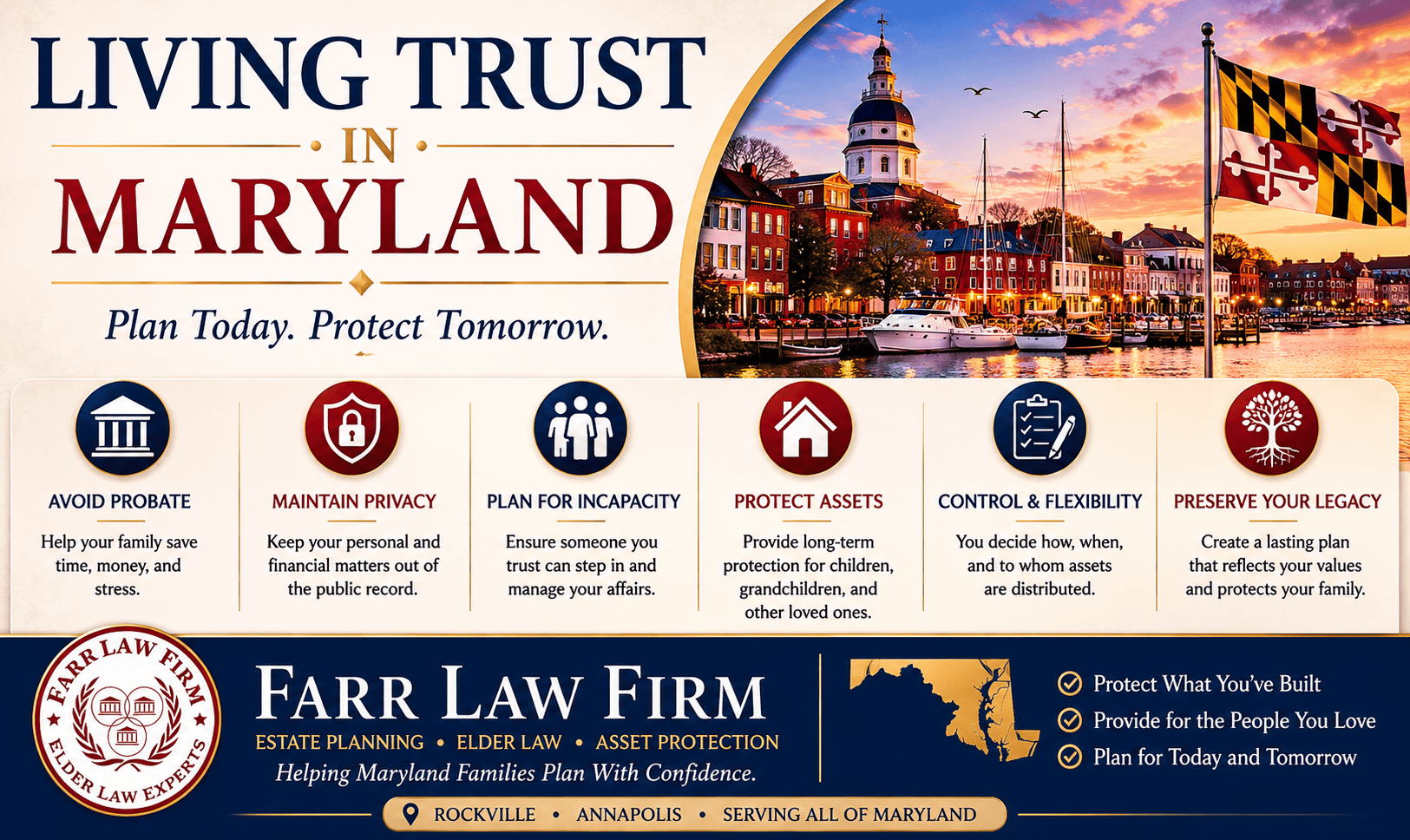
- Avoiding probate for properly funded trust assets;
- Creating a plan for incapacity;
- Maintaining privacy regarding family wealth and inheritance decisions;
- Reducing administrative burdens on surviving family members;
- Providing long-term protection for beneficiaries; and
- Creating continuity when real estate, investments, and other assets are involved.
Many families discover that a trust is not merely a death-planning tool. It can be equally important during life if illness, disability, or cognitive decline occurs.
Can a Living Trust Avoid Probate in Maryland?
One of the primary reasons Maryland residents establish living trusts is to avoid probate for assets that are properly titled in the trust.
Probate is the legal process through which assets owned individually at death are transferred to heirs and beneficiaries. Depending on the circumstances, probate can involve court filings, administrative requirements, delays, and additional costs.
When assets are owned by a properly funded trust, the successor trustee can generally administer those assets without opening a probate estate for those particular assets.
The trust itself does not avoid probate. Proper funding avoids probate. A trust that is never funded often fails to achieve one of its primary purposes.
Maryland Real Estate and Living Trusts
For many families, the most valuable asset they own is real estate. Homes, vacation properties, rental properties, and investment real estate are often excellent candidates for trust ownership.
Holding Maryland real estate in a trust can simplify administration after death and may help avoid the need for probate proceedings involving that property.
Families who own property in multiple states often find trusts particularly useful because properly titled trust assets can help avoid multiple probate proceedings in different jurisdictions.
What Happens If You Become Incapacitated?
Many people create living trusts because they are concerned about incapacity rather than death.
If you become unable to manage your affairs because of illness, injury, dementia, stroke, or another condition, your successor trustee can step in and manage trust assets according to the trust terms.
This continuity can help avoid disruptions in bill payment, investment management, property management, and other financial matters.
A living trust should generally be coordinated with a financial power of attorney and an advance medical directive as part of a comprehensive incapacity-planning strategy.
For more information, see Financial Powers of Attorney and Advance Medical Directives.
Revocable Trusts and Irrevocable Trusts Are Not the Same
Many people use the term “living trust” when they really mean a revocable living trust.
A revocable living trust allows the creator to retain significant control. The trust can usually be amended, restated, or revoked during the creator’s lifetime.
An irrevocable trust is different. The creator generally gives up certain rights and powers. Those restrictions are often what make irrevocable trusts useful for asset protection, tax planning, charitable planning, special needs planning, and long-term care planning.
An irrevocable trust is not necessarily permanent or unchangeable. Depending on the trust language and applicable law, various modification techniques may be available. The important distinction is that the creator no longer retains unrestricted control over the assets.
Can a Living Trust Protect Assets From Nursing Home Costs?
A revocable living trust generally does not protect assets from nursing home expenses or Medicaid long-term care resource requirements.
This misunderstanding causes many families to believe they have completed long-term care planning when they have not.
Because the creator generally retains control over assets in a revocable trust, those assets are ordinarily still considered available for long-term care planning purposes.
Long-term care planning often requires different strategies, including properly designed irrevocable trusts, Medicaid Asset Protection Trusts, Veterans Asset Protection Trusts, long-term care insurance, caregiver agreements, annuity planning, or other planning techniques depending on the circumstances.
For more information, see Living Trust Plus® Medicaid Asset Protection Trust and Medicaid Asset Protection and Life Care Planning.
Using Trusts to Protect Children and Grandchildren
A trust can continue long after the person who created it has died.
Instead of distributing assets outright, a trust can hold assets for beneficiaries and distribute them according to standards chosen by the trust creator.
This flexibility can be valuable when beneficiaries are young, financially inexperienced, vulnerable to creditors, involved in difficult marriages, struggling with substance abuse issues, or simply not ready to manage substantial wealth.
Many modern estate plans use continuing trusts rather than outright inheritances because once assets are distributed outright, the protections provided by the trust are often lost.
Trust Planning for Beneficiaries With Disabilities
Families with disabled beneficiaries often have concerns about SSI, Medicaid, and other means-tested public benefits.
Improper inheritance planning can jeopardize eligibility for important public benefits.
Specially designed trusts can often preserve eligibility while still allowing assets to be used to improve quality of life.
For additional information, see Special Needs Trust Planning.
The Most Common Living Trust Mistakes
Some of the most common trust-planning mistakes include:
- Creating a trust but never funding it;
- Failing to transfer real estate into the trust;
- Ignoring beneficiary designation coordination;
- Choosing the wrong successor trustee;
- Using generic online trust documents;
- Failing to update the trust after major life events;
- Assuming a revocable trust provides asset protection; and
- Failing to coordinate the trust with powers of attorney and healthcare documents.
Is a Living Trust Right for Every Maryland Resident?
No. Some individuals may be adequately served by a simple will-based plan.
Others may benefit significantly from a trust-based plan, particularly if they own real estate, have blended families, own substantial assets, have beneficiaries requiring special planning, own property in multiple states, or want a more robust incapacity-planning strategy.
The appropriate solution depends on the individual’s goals, family structure, assets, and long-term concerns.
Talk With a Maryland Living Trust Attorney
Farr Law Firm helps Maryland residents with revocable living trusts, irrevocable trusts, Medicaid Asset Protection Trusts, special needs trusts, powers of attorney, advance medical directives, probate avoidance planning, and comprehensive estate planning.
Call our Maryland offices to schedule a consultation:
- Rockville: 301-519-8041
- Annapolis: 410-573-4818
We assist clients throughout Maryland, including Montgomery County, Prince George’s County, Anne Arundel County, Howard County, Frederick County, Baltimore County, Baltimore City, and surrounding communities.
Yoast SEO Title
What Is a Living Trust in Maryland?
Yoast Meta Description
Learn how a Maryland living trust works, how trusts can help avoid probate, plan for incapacity, protect beneficiaries, and fit into a comprehensive estate plan.
Yoast Focus Keyphrase
living trust in Maryland
Call our Maryland offices to schedule a consultation:
- Rockville: 301-519-8041
- Annapolis: 410-573-4818
We help clients throughout Maryland, including Montgomery County, Prince George’s County, Anne Arundel County, Howard County, Baltimore County, Baltimore City, Frederick County, and surrounding communities.