

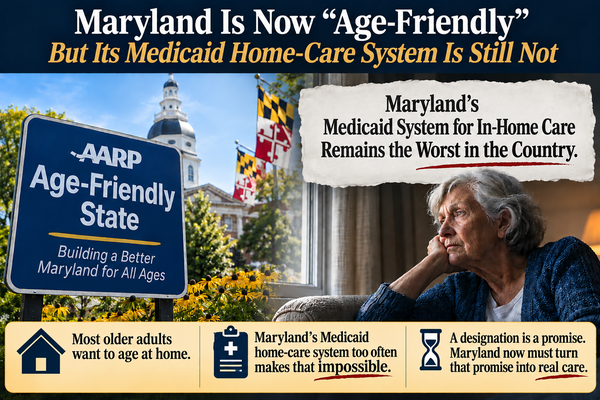
Maryland has officially joined AARP’s Network of Age-Friendly States and Communities, committing the state to a long-term strategy intended to make Maryland a better place to grow older.
That sounds impressive. It is also dangerously incomplete.
Maryland may now carry the label “Age-Friendly,” but Maryland’s Medicaid system for older adults who need long-term care at home remains, in my professional experience, the worst in the country.
The AARP designation is not an award for services already delivered. It is not a finding that Maryland seniors can obtain adequate in-home care. It is not an audit of Maryland Medicaid. It is not proof that older adults can safely remain in their homes when they become frail, disabled, or cognitively impaired.
The designation reflects Maryland’s agreement to participate in a planning framework and work toward future improvements involving housing, transportation, public spaces, communication, social participation, health services, and other features of community life. AARP itself describes the designation as both a recognition of progress and “a call to keep building.”
Planning is useful. Branding is easy. Delivering actual care is what matters.
Maryland Has Adopted a 10-Year Aging Strategy
Maryland’s new designation follows enactment of the Longevity Ready Maryland Act, which takes effect October 1, 2026.
The act requires the Maryland Secretary of Aging to lead implementation of the Longevity Ready Maryland Plan. The official enrolled legislation describes the plan as a multisector effort intended to transform “programs, services, policies, institutions, and systems” in response to Maryland’s growing population of older adults. The act also requires public monitoring of implementation and an updated plan every four years.
These are worthwhile objectives.
But a ten-year plan does nothing for the Maryland resident who needs a home-care aide today.
A public dashboard does nothing for the spouse who is bathing, dressing, lifting, and supervising a husband or wife around the clock.
An Age-Friendly certificate does nothing for the person with dementia whose family has exhausted its savings paying privately for care while waiting for Maryland Medicaid to provide meaningful assistance.
“Age-Friendly” Does Not Mean Home-Care Friendly
Most older adults want to remain at home. Maryland’s public policy language repeatedly acknowledges that goal.
The state’s Medicaid system does not reliably make that possible.
Maryland has long maintained a confusing maze of Medicaid long-term care programs, including the Community Options Waiver, Community First Choice, Increased Community Services, and other programs with different eligibility rules, enrollment pathways, service limits, and institutional-transition requirements.
The most serious problem is not merely administrative complexity. The problem is that an older Maryland resident who needs immediate Medicaid-funded care at home frequently cannot obtain enough care — or any meaningful care — without first entering a nursing home.
That is not aging in place.
That is institutionalization as an admission requirement.
In our earlier article “Maryland Medicaid Waivers Have a Wait-List of 21,000 Names — Is That Ever Going to Change?” we explained how thousands of Maryland residents had been placed on a service registry for Medicaid home- and community-based services. The Washington Post also wrote about this issue.
Many people on that registry entered nursing homes or died before receiving an invitation to apply. Maryland had also stopped accepting new names for portions of the registry, leaving families with no meaningful route to obtain timely home-care coverage.
The state has made changes since that article was published. It has expanded some programs and taken steps intended to reduce portions of the backlog.
Those changes do not alter the basic reality we see in our practice: Maryland’s Medicaid home-care system remains dramatically less accessible and less useful than the systems operating in Virginia and the District of Columbia.
Virginia and DC Provide a Clear Contrast
Our firm handles Medicaid planning in Virginia, Maryland, and Washington, DC. That gives us a direct view of how these systems operate in actual cases, not merely how they are described in agency brochures.
In Virginia, an eligible person who meets the required level of care can obtain services through the Commonwealth Coordinated Care Plus Waiver without joining a years-long registry for older adults and people with physical disabilities.
In Washington, DC, the Elderly and Persons with Physical Disabilities Waiver can provide substantial in-home assistance to eligible residents who meet the program requirements.
Both systems have administrative problems. Both face caregiver shortages.
Neither system is perfect.
But both provide a real pathway for an eligible person living in the community to obtain Medicaid-funded long-term care without first being warehoused in a nursing home.
Maryland often does not.
Maryland’s Medicaid Problems Extend Beyond Long-Term Care
Maryland’s failures are not confined to home-care waivers.
As we explained in “Medicaid Recipients Sue Maryland Over Dysfunctional Eligibility System”, Medicaid recipients and disability organizations filed suit in September 2025 alleging that the Maryland Department of Health had improperly terminated coverage for eligible individuals.
The complaint alleged that Maryland:
• Wrongfully terminated Medicaid benefits
• Sent critical notices to outdated addresses
• Issued confusing or incomplete explanations
• Failed to provide meaningful advance notice
• Forced recipients into lengthy appeals while they went without health coverage.
That litigation concerns health-coverage Medicaid rather than long-term care Medicaid. The distinction matters, but the pattern is the same.
Maryland creates overly complicated systems, relies on unreliable administrative processes, and places the cost of government error on elderly, ill, and disabled residents who are least able to absorb it.
AARP’s Designation Should Be Treated as a Deadline, Not a Victory
Maryland should not use its Age-Friendly designation as a public-relations shield.
The designation should be treated as a demand for measurable results.
A genuinely age-friendly Maryland must do more than improve parks, transportation, volunteer opportunities, and public communication. Those initiatives have value, but they do not address the most serious threat facing older adults: the inability to obtain and pay for long-term care.
Maryland should be required to publish measurable information showing:
• How many people are waiting for each Medicaid home- and community-based program
• How long applicants wait from initial request to actual service delivery
• How many people die or enter nursing homes while waiting
• How many approved participants cannot obtain authorized services because no caregiver is available
• How many waiver positions remain unfilled
• How many applicants are denied, and why
• How many eligibility determinations exceed federal processing deadlines
• How many Medicaid recipients lose coverage because of administrative errors
• How Maryland’s spending on home- and community-based care compares with its spending on institutional care
Without this information, “Age-Friendly” is a slogan rather than a standard.
Maryland Must Make Home Care an Actual Option
A serious reform agenda would include several immediate changes.
• Create a direct and timely pathway into Medicaid home-care programs for people living in the community
• Eliminate rules and practices that force people into nursing homes before they can obtain adequate services at home
• Increase reimbursement rates enough to attract and retain qualified caregivers
• Simplify overlapping programs and create one understandable application process
• Require firm eligibility-processing deadlines and automatic escalation when deadlines are missed
• Preserve benefits while recipients challenge erroneous terminations
• Provide transparent public reporting on waiting times, denials, and unfilled services
• Fund enough home-care capacity to make aging in place a real choice rather than a political talking point
Maryland’s new aging strategy specifically calls for changes to programs, services, policies, institutions, and systems. That language is broad enough to include Medicaid long-term care. The state must now prove that its plan reaches the people whose lives depend on those systems.
Do Not Confuse a Designation with a Safety Net
Maryland has now promised to become more age-friendly.
That promise should be welcomed, but it should not be mistaken for an accomplishment.
Families making retirement, relocation, caregiving, and long-term care decisions must evaluate what Maryland’s programs deliver today — not what state officials hope to build over the next decade.
For Maryland residents who need nursing home Medicaid, effective Medicaid Asset Protection Planning remains possible, even during a crisis.
For Maryland residents who expect Medicaid to pay for extensive care at home, the options are far more limited. Advance planning, private long-term care insurance, family caregiving, privately paid care, home-equity strategies, and, in some cases, relocation may need to be considered long before a crisis develops.
Maryland can call itself Age-Friendly.
Until the state creates a functional, timely, and adequately funded Medicaid home-care system, families should not assume that the label means Maryland will help them age safely at home.
