

A Growing Threat to Homeowners
Deed fraud, sometimes called “house theft,” has become a growing concern across Virginia and the nation. In a typical scheme, a fraudster forges a deed, records it among the land records, and attempts to transfer ownership of a property without the true owner’s knowledge. The fraudster may then try to sell the property, obtain loans against it, or create title problems that can take years and substantial legal fees to resolve.
Several years ago, we discussed this issue in our article “Deed Fraud May Be on the Rise: Learn How to Spot if You’re a Victim of House Theft.” While homeowners have long been vulnerable to this type of fraud, Virginia has now enacted new legislation designed to provide an additional layer of protection.
What Virginia’s New Law Does
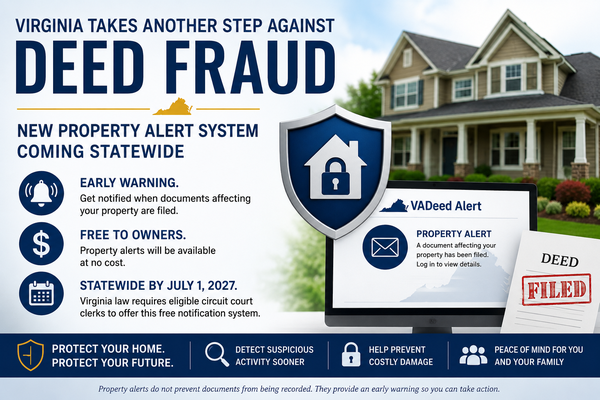
During the 2026 General Assembly session, Virginia enacted Senate Bill 316, which contains several anti-fraud measures affecting real estate transactions. One of the most significant provisions requires circuit court clerks that offer electronic land-record filing systems to establish a free property alert notification system for property owners.
Under the new law:
• Property owners will be able to enroll their property in a notification system at no cost.
• The system must notify the owner whenever documents affecting or purporting to affect the property are filed in the land records.
• The property alert requirement becomes effective July 1, 2027.
The goal is straightforward: if a suspicious deed, deed of trust, mortgage, or other document is recorded against your property, you will receive notice much sooner and can take action before the problem becomes significantly worse.
This Is Not an Entirely New Concept
Several Virginia jurisdictions have already implemented similar systems.
For example, property owners in jurisdictions such as Prince William County, Arlington County, and Loudoun County can already sign up for free property alerts that notify them when documents are recorded under their names or associated with their properties.
Here’s the current status:
- Prince William County (including Manassas and Manassas Park) uses its own GovOS/NUEMO Property Alerts system at https://www.pwcva.gov/department/circuit-court/property-alerts-system.
- Arlington County uses its own Cloud Search/GovOS Property Alert system at https://www.arlingtonva.us/Government/Departments/Courts/Circuit-Court/Land-Records/Land-Records-Property-Alerts.
- Loudoun County does not appear to currently offer a deed/property alert system.
- Fairfax County (and City of Fairfax) does not yet appear to offer a notification service.
Virginia’s new legislation effectively expands this concept statewide by requiring eligible circuit courts to offer such systems.
In fact, the Virginia court system has already developed a statewide platform known as: VA Deed Alert, and the following counties and cities already participate: Accomack County; Alexandria City; Alleghany County; Amelia County; Amherst County; Appomattox County; Bath County; Bland County; Botetourt County; Bristol City; Brunswick County; Buckingham County; Buena Vista City; Campbell County; Carroll County; Charles City County; Charlotte County; Craig County; Culpeper County; Cumberland County; Dickenson County; Dinwiddie County; Essex County; Floyd County; Franklin County; Frederick County; Fredericksburg City; Giles County; Gloucester County; Goochland County; Grayson County; Greene County; Greensville County; Halifax County; Hampton City; Henry County; Hopewell City; King William County; King and Queen County; Lancaster County; Lee County; Lunenburg County; Lynchburg City; Madison County; Martinsville County; Mathews County; Mecklenburg County; Middlesex County; Nelson County; Newport News City; Norfolk City; Northampton County; Northumberland County; Nottoway County; Orange County; Page County; Patrick County; Petersburg County; Pittsylvania County; Portsmouth City; Powhatan County; Prince Edward County; Prince George County; Rappahannock County; Richmond City; Roanoke City; Roanoke County; Rockbridge County; Russell County; Salem City; Shenandoah County; Smyth County; Southampton County; Staunton City; Tazewell County; Warren County; Waynesboro City; Williamsburg-James City County; Winchester City; Wythe County; and York-Poquoson County.
More Virginia localities should be enrolling in the near future.
What Property Alerts Can and Cannot Do
Property alerts are valuable, but homeowners should understand their limitations.
A property alert system does not:
• Prevent a fraudulent document from being recorded.
• Verify whether a document is legitimate.
• Guarantee that fraud will be stopped.
Instead, it provides an early warning system that allows you to investigate suspicious filings quickly. Many existing programs emphasize that the alerts merely notify owners that recording activity has occurred and that further investigation may be necessary.
The sooner fraudulent activity is discovered, the easier it often is to limit the damage.
Additional Protections Included in the New Law
The legislation does more than create property alerts.
As of July 1, 2026, Virginia is also strengthening requirements for notaries and settlement agents involved in real estate transactions.
Among other changes:
• Notaries must maintain records of notarial acts.
• Settlement agents must exercise reasonable care in verifying the identity of sellers.
• Future notary education requirements will include training concerning real estate fraud and financial exploitation of elderly persons.
These measures are intended to make it more difficult for fraudsters to successfully impersonate property owners during real estate transactions.
Why Seniors Are Frequently Targeted
Older adults are often prime targets for deed fraud.
Fraudsters frequently look for:
• Vacant properties
• Rental properties
• Vacation homes
• Properties owned free and clear
• Homes owned by individuals who have moved into assisted living facilities or nursing homes
• Properties owned by elderly individuals who may not regularly monitor land records
This is one reason why families should pay close attention to real estate owned by aging parents and grandparents.
What Homeowners Should Do Now
Even before the statewide requirement takes effect in July 2027, many Virginia homeowners may already have access to a local property alert system.
If your circuit court clerk currently offers deed alerts or property notifications, enroll immediately.
In addition:
• Review your property tax records periodically.
• Open and read correspondence from your locality.
• Monitor mortgage statements and title-related mail.
• Be cautious about sharing copies of deeds and personal identifying information.
• Consult an attorney immediately if you receive notice of an unfamiliar document affecting your property.
The Bottom Line
Virginia’s new property alert law is a positive development. While it will not eliminate deed fraud, it should help homeowners detect suspicious activity much sooner.
Early detection is often the difference between a manageable legal problem and a lengthy, expensive title dispute.
If you own real estate in Virginia, particularly a second home, rental property, inherited property, or a home owned by an aging parent, take advantage of any property alert system available in your locality and plan to enroll once the statewide system becomes fully implemented.
Concerned about protecting your home, rental property, or other real estate assets from probate, lawsuits, nursing home costs, and other risks? Contact the experienced Virginia Elder Law and Virginia Estate Planning attorneys at the Farr Law Firm.
