

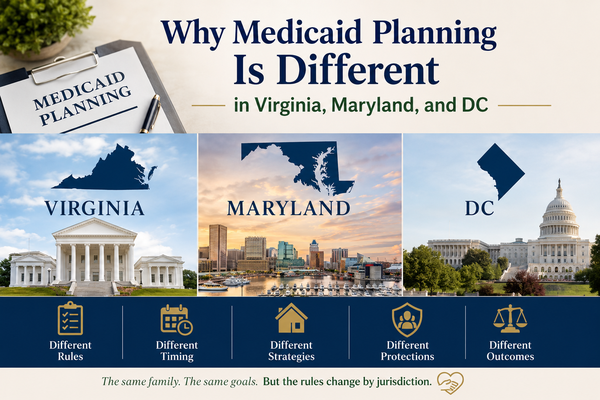
Why Virginia Medicaid Planning Is Different from Maryland Medicaid Planning and DC Medicaid Planning
Families often assume that Medicaid Planning works the same way throughout Virginia, Maryland, and the District of Columbia.
That assumption is wrong.
Medicaid is partly federal, but long-term care Medicaid is administered jurisdiction by jurisdiction. Virginia, Maryland, and the District of Columbia each have their own Medicaid agency, eligibility rules, forms, manuals, waiver programs, verification practices, application procedures, and local processing customs. That means Virginia Medicaid Planning, Maryland Medicaid Planning, and DC Medicaid Planning are not interchangeable. The goal may be similar in each jurisdiction: helping a person qualify for long-term care Medicaid while protecting a spouse, preserving assets when legally possible, avoiding preventable penalties, and preventing a family from spending more than necessary on nursing home care or other long-term care.
But the correct strategy depends on where the Medicaid application will be filed.
A plan that works for Virginia Medicaid Asset Protection may not work for Maryland Medicaid Asset Protection.
A Maryland Medicaid Asset Protection plan may not work as a DC Medicaid Asset Protection.
A DC Medicaid Asset Protection Plan involves different program structure, different eligibility pathways, and different practical issues than a Virginia Medicaid Asset Protection Plan or a Maryland Medicaid Asset Protection Plan.
That is why families should not rely on generic Medicaid advice from the internet, from AI Chat engines, from neighbors, from a nursing home business office, from someone who handles Medicaid cases in other jurisdictions, or from someone only trained in federal Medicaid laws, such as many Certified Medicaid Planners who are generally not Certified Elder Law Attorneys.
Medicaid Planning must be handled under the rules of the jurisdiction that will decide the application.⠀
Medicaid Planning Is Legal, But It Must Be Done Correctly⠀
Medicaid Planning is not about hiding assets. It is about understanding and applying the law.
Done properly, Medicaid Planning can help protect a spouse from impoverishment, preserve a family home, avoid unnecessary spend-down, and keep more resources available for care that Medicaid does not cover.
Done poorly, Medicaid Planning can trigger a transfer penalty, delay eligibility, cause a denial, or create tax and legal problems that could have been avoided.
For more background, read Is Medicaid Planning Legal and Ethical? and Medicaid Planning Ethics and Complexity.⠀
Virginia, Maryland, and DC Do Not Use the Same Resource Rules⠀
One of the first major differences is the resource limit.
A person applying for long-term care Medicaid must have countable resources below the applicable limit. But the applicable limit is not the same everywhere.
Virginia Medicaid, Maryland Medicaid, and DC Medicaid each use their own resource standards.
For example, in 2026, Virginia Medicaid’s standard resource limit for many single aged, blind, or disabled Medicaid applicants is $2,000. Maryland’s medically needy resource standard for one person is $2,500. DC’s medically needy resource standard for one person is $4,000.
These numbers may seem small compared to the cost of long-term care, but even small differences can matter when a family is trying to file an application correctly and avoid another month of private pay. And these small differences are just the tip of the iceberg when it comes to Medicaid differences across the DC, Maryland, and Virginia (DMV) area.
A single applicant with a modest bank balance might be over the limit in one jurisdiction but not in another.
A married couple may need a different spend-down strategy depending on whether the Medicaid application is being filed in Virginia, Maryland, or DC.
This is one of the first reasons jurisdiction matters.
The same family balance sheet can produce different Medicaid Planning advice depending on the state.⠀
Timing Rules Can Change the Entire Strategy⠀
Medicaid eligibility is not based only on how much the applicant owns.
It also depends on when the applicant owns it.
That timing issue can be critical.
Virginia and Maryland do not treat resource timing the same way. In Virginia, resource eligibility can depend on whether the applicant was within the resource limit during the month. In Maryland, the first moment of the first day of the month can be critical in determining resource eligibility for that month.
That difference is not academic.
It can affect when to file, when to spend down, when to pay bills, when to move money, and when Medicaid coverage can begin.
This is one of the most common areas where families make mistakes.
They assume that if the money is spent down eventually, the application will be approved retroactively to the date they wanted.
That is not always true.
In some cases, filing too early causes a denial.
In other cases, filing too late causes the family to lose a month of potential eligibility.
In still other cases, the problem is not the amount of money, but the date on which the money was still sitting in the wrong account.
Virginia Medicaid Planning, Maryland Medicaid Planning, and DC Medicaid Planning each require close attention to the timing rules that apply in that jurisdiction.⠀
The Five-Year Look-Back Exists in All Three Jurisdictions, But the Details Matter⠀
Many families have heard of the five-year Medicaid look-back. They know that Medicaid may review transfers made during the five years before a long-term care Medicaid application. That general statement is correct, but incomplete.
The real questions are more specific:
• What counts as a transfer?
• Was the transfer for fair market value?
• Was the transfer made by the applicant, the spouse, an agent under power of attorney, a trustee, or someone else acting for the applicant?
• Was the transfer made to a spouse, child, trust, caregiver, sibling, charity, or third party?
• Was the transferred asset cash, real estate, a life estate, a joint account, an annuity, or another asset?
• Was the applicant already receiving Medicaid, already institutionalized, or applying for a waiver program?
• Does an exception apply?
The phrase “five-year look-back” does not answer these questions.
That is why transfer planning must be jurisdiction-specific.
The same deed, gift, trust transfer, or account change may be treated differently depending on whether the case is being handled in Virginia, Maryland, or DC.
The Home Is Often the Most Important Asset⠀
For many families, the home is the largest asset.
It is also one of the most misunderstood Medicaid assets.
The home may be treated differently from a bank account, but that does not mean the home can be ignored.
The home may raise several Medicaid Planning issues:
• Whether the home is exempt during the applicant’s lifetime
• Whether the applicant has an intent to return home
• Whether a spouse, disabled child, minor child, sibling, or caregiver child lives in the home
• Whether the home equity limit applies
• Whether the home should be sold, rented, retained, transferred, or protected through advance planning
• Whether estate recovery could apply after death
• Whether a deed, life estate, or trust transfer would create a penalty
• Whether the home is needed to support a spouse or disabled family member
A home strategy that is appropriate in Virginia may not be appropriate in Maryland.
A Maryland deed strategy may not be the right strategy in DC.
A DC waiver case may require a different analysis than a Virginia nursing home case.
Families should be especially careful before signing a deed, adding a child to the title, creating a life estate, transferring the home to a trust, or selling the home during a Medicaid crisis.
Real estate planning and Medicaid Planning must be coordinated.
Retirement Accounts Are Treated Differently
Just as the home is the largest asst for many families, IRAs are the largest asset for some people. And just as the treatment of the home is different in Virginia from Maryland and DC, the treatment of IRAs, 401(k)s and similar plans is completely different (and much more favorable) in DC compared to Virginia and Maryland. This can make the vital difference in Medicaid Planning for some families who live in Northern Virginia and suburban Maryland, because getting DC Medicaid can be a huge benefit in many cases where individuals have large retirement accounts.
Married-Couple Medicaid Planning Is Especially State-Specific⠀
Married-couple Medicaid Planning is one of the most technical areas of Elder Law.
When one spouse needs nursing home care or other long-term care, the law contains protections for the spouse who is still living at home.
This spouse is often called the community spouse.
The purpose of spousal impoverishment rules is to prevent the spouse at home from becoming impoverished merely because the other spouse needs long-term care.
But the details matter.
The Medicaid agency will look at the couple’s assets, income, ownership structure, account titling, transfers, and post-eligibility obligations.
The agency may distinguish between assets owned by the institutionalized spouse, assets owned by the community spouse, jointly owned assets, retirement accounts, income streams, annuities, and other property.
The Medicaid plan must answer practical questions:
• How much can the community spouse keep?
• Which assets are countable?• Which assets are exempt?
• What must be spent down?
• What should not be spent down?
• Should assets be transferred from one spouse to the other?
• When must the transfer occur?
• How will the institutionalized spouse’s income be handled?
• Can the community spouse receive more income through a Medicaid spousal allowance?
• What happens if the community spouse later needs care?
This is not an area for guesswork.
Married-couple Medicaid Planning must be tailored to the state rules and to the family’s actual facts.
For more background on spousal Medicaid Planning in Virginia, read This Virginia Law Makes It A MUST to Do Medicaid Planning for Married Couples.⠀
Nursing Home Medicaid Is Not the Same as Home-Care Medicaid⠀
Many families use the phrase “Medicaid Planning” as if there is only one type of long-term care Medicaid.
There is not.
A person may need:
• Nursing home Medicaid
• Home and community-based waiver services
• In-home care
• Adult day care
• Assisted living support
• Memory care support
• PACE services
• Other long-term services and supports
Each program has its own eligibility rules, practical limitations, and availability issues.
Virginia, Maryland, and DC do not have identical long-term care systems.
A family that wants to keep a parent at home in Maryland may face different options and limits than a family trying to keep a parent at home in Virginia or DC.
This distinction matters because Medicaid Planning is not only about financial eligibility. It is also about care eligibility.
A person may meet the financial rules but still fail to qualify for a particular waiver or service because the person does not meet the required level of care, does not have access to an available waiver slot, does not meet program-specific requirements, or cannot find a participating provider.⠀
Assisted Living and Memory Care Create Additional Problems⠀
Families are often surprised to learn that Medicaid does not cover every type of long-term care.
Nursing home Medicaid is one thing.
Assisted living and memory care are different.
In many cases, families want Medicaid to pay for assisted living or memory care because they do not want a nursing home placement.
That is understandable.
But Medicaid coverage for assisted living and memory care depends on the jurisdiction, the available programs, the facility, the person’s care needs, and the program’s financial and medical eligibility rules.
This is one reason Medicaid Planning should begin before a crisis.
If the family waits until the loved one is already in assisted living or memory care and the money is almost gone, the planning options may be narrower.
The family may discover too late that the current facility does not accept the relevant Medicaid program, that waiver services are limited, or that the person’s care needs now require a different level of care.
Good Medicaid Planning looks beyond the immediate application.
It considers where the person is likely to need care over the next several years.⠀
Trusts, Deeds, Life Estates, and Annuities Must Be Reviewed Carefully⠀
Trusts, deeds, life estates, annuities, and beneficiary designations can be useful tools. They can also create major Medicaid problems if used incorrectly. The question is not whether a tool is “good” or “bad.” The question is whether it is appropriate for that client, in that jurisdiction, at that time, for that type of Medicaid benefit.
A Medicaid Asset Protection Trust may be appropriate for advance planning.
A deed may be appropriate in one case and dangerous in another.
A life estate may preserve some rights but create other consequences.
An annuity may be helpful in one married-couple case and harmful in another.
A beneficiary designation may work for probate avoidance but fail for Medicaid Planning.
Families often create problems when they focus on one goal and ignore the others.
For example, adding a child to a deed may seem simple, but it can create Medicaid transfer issues, tax issues, creditor issues, divorce exposure, family conflict, and loss of control.
Similarly, moving assets into the wrong trust can create ineligibility or fail to provide the intended protection.
A properly designed Living Trust Plus® Medicaid Asset Protection Trust may be part of a strong long-term care planning strategy, but it must be created and funded correctly and well in advance of the need for Medicaid.⠀
Local Medicaid Offices and Practical Procedures Matter⠀
Medicaid Planning is not only about reading the rules. It also involves knowing how applications are processed in the real world. Virginia, Maryland, and DC have different agencies, different forms, different verification requests, different worker practices, different review timelines, and different appeal procedures.
Families often underestimate the burden of documentation. A Medicaid application may require bank statements, deeds, tax returns, retirement account statements, life insurance information, annuity contracts, trust documents, vehicle titles, funeral contracts, medical verifications, facility paperwork, and explanations of deposits, withdrawals, transfers, and account closures.
The more complicated the financial history, the more important it is to prepare the application properly before filing. A poorly prepared application can create delay, denial, unnecessary requests for information, and avoidable private-pay months. This is especially true when the applicant has multiple accounts, real estate, a trust, prior transfers, business interests, annuities, jointly owned property, or out-of-state assets.⠀
The Same Family Facts Can Produce Different Advice⠀
Consider a married couple with a home, bank accounts, retirement accounts, and one spouse entering long-term care.
In Virginia, the planning may focus on application-month resource rules, spousal protections, transfer timing, home equity, and whether assets can be repositioned before or during the application process.
In Maryland, the planning may focus more heavily on first-day-of-the-month resource rules, the exact titling of assets, protected-period transfers between spouses, and Maryland’s specific treatment of institutionalized-person eligibility.
In DC, the planning may focus on DC’s long-term care eligibility standards, income rules, resource rules, waiver requirements, and the practical availability of services.
The family facts may be the same. The advice may not be. That is why regional knowledge matters.
It is not enough to understand Medicaid in general. The planner must understand the Medicaid rules and procedures where the application will actually be filed.⠀
Why Early Planning Matters
Crisis Medicaid Planning is sometimes possible, but early planning is almost always better.
When planning is done early, the family may have more options to protect the home, preserve savings, plan for a spouse, structure care, and avoid transfer penalties.
When planning is delayed, options shrink.
Waiting can force a family into rushed decisions, unnecessary spend-down, preventable tax consequences, poor facility choices, or avoidable Medicaid penalties.
Early planning is especially important when the family owns a home, has retirement accounts, wants to protect assets for a spouse or disabled child, or wants to preserve flexibility for assisted living, memory care, or in-home care.
For families who want to understand the planning process before a crisis, the Medicaid Planning Stress Reduction Tool is a useful place to start.⠀
Key Takeaways⠀
Virginia Medicaid Planning is different from Maryland Medicaid Planning.
Maryland Medicaid Planning is different from DC Medicaid Planning.
DC Medicaid Planning is different from both.
The differences involve resource limits, timing rules, transfer rules, spousal protections, home equity rules, waiver eligibility, administrative procedures, documentation requirements, and local practice.
Families who ignore these differences risk delay, denial, unnecessary spend-down, avoidable penalties, and loss of assets that might have been protected with proper planning.
Generic Medicaid advice is not enough. Medicaid Planning must be specific to the applicant, the assets, the care setting, the family goals, and the jurisdiction deciding the case.
For help with Medicaid Planning in Virginia, Maryland, or the District of Columbia, get in touch with Farr Law Firm. We are one of the only law firms in the region that know the Medicaid laws in all 3 jurisdictions and do Medicaid Asset Protection Planning in Virginia, Medicaid Asset Protection Planning in Maryland, and Medicaid Asset Protection Planning in Washington, DC.